

Conclusion – Climate Change Series
A gap exists between what municipal governments say about climate action and what they actually accomplish. This article is the last in an eight-part series exploring that reality.
It’s no secret that much of the political right in the U.S. has embraced objectives laid out in the Heritage Foundation’s Project 2025. In a polarized America, Project 2025 has been described as an authoritarian initiative featuring mass deportation, the suspension of civil liberties, and the consolidation of executive power. It also proved to be an effective blueprint for President Trump’s second term.
Of relevance here is Project 2025’s aim to both eliminate support for renewable energy projects and maximize fossil fuel production.
This series has considered the climate rhetoric and reality in Halifax and Portland. Over a period of 20 years, between 2000 and 2020, the two municipalities were going in markedly different directions. Their unfolding stories suggest that some municipalities would do well to look in the mirror before claiming moral superiority over climate change deniers.
In Halifax, the gap between climate rhetoric and reality has been immense. Simply put, that municipality has in place policies and regulations that maximize CO2 emissions. A so-called friend of the environment like Halifax makes one wonder who even needs enemies like those aligned with Project 2025.
Until recently, Portland’s rhetoric-reality gap has been small, but this success story might not prevail.
The principal point made with this series is that, for all intents and purposes, most municipalities fail to pursue four objectives necessary to consistently develop quality human-scale development. Given this failure to enact meaningful change, municipal governments are, practically speaking, aligned with those who say climate change is a hoax.
This series has considered:
- Why municipalities are at the center of the climate crisis
- How culture shapes climate rhetoric and reality
- How municipalities virtue signal with climate action plans
- How demolishing human-scale development directly undermines emissions reduction
- Research that consistently shows how erecting tall buildings maximizes emissions
- Research that consistently shows how human-scale, courtyard-style buildings accommodate high-rise densities
- Regulatory reform that promotes human-scale development minimizes emissions
Looking to the future in Halifax and Portland, there are two interrelated stories. One can be told quickly. The other is more nuanced but can be briefly summarized.
Halifax’s future is fixed. It operates in a national context in which rapid, government-engineered population growth is used to fuel poorly conceived and executed urban development. This will not change in the years ahead. It’s a pathological body politic that will continue to produce worst-case outcomes for the climate and the environment.
Nova Scotians operate in a distinctive culture steeped in mediocrity, insecurity, desperation, and a dedication to the crudest forms of economic development. This assessment is in line with those made by prominent urbanists over five decades ago. It’s worth reiterating that Nova Scotia’s per capita GDP is now well below Mississippi’s.
In 1970, Halifax’s governing and economic ruling class were warned about the consequences of pursuing economic growth for the benefit of the few at the expense of quality of life. Today, self-congratulatory messaging regarding Canada’s “multicultural” future is used to mask the degradation of housing affordability, health care, mobility, employment opportunity, aesthetics, and culture. Like Canada as a whole, mass immigration and high-rise development are now Halifax’s raison d’être.
| In 2025, Canadian filmmaker Sangita Iyer completed a two-part documentary about mass immigration titled Canada Unplugged (Watch the Trailer, Part 1 and Part 2). Canadian podcaster Kushal Mehra talks with Sangita about her work in his podcast titled Immigration Disaster In Canada. |
In contrast to Halifax, Portland’s future is more difficult to predict. Maine’s political leadership has not sought to double or triple the state’s population. Insecurities of the sort endemic to Halifax haven’t hamstrung Portland’s municipal leadership. Portlanders rarely speak of becoming a “world-class city” or “the next Boston.” Instead, Portland has largely focused on authenticity and quality of life. Its star has risen nationally as a result.
In the first two decades of the twenty-first century, Portland’s municipal council, planning board, and planning staff established a track record of making Portland a better version of itself. You see this aspiration expressed in both their master plan and climate action plan.
And as shown in Part 7 of this series, the quality of much of Portland’s development has, to date, been high. Underpinning all of this has been a level of commitment to both Portlanders’ values and public participation of a sort that does not exist in Halifax.
That said, there are cases where the city has allowed Portland developers to operate in ways that erode what makes Portland unique—but it’s a matter of degree. Simply put, the cultural differences are very real, and you see those differences reflected in the urban fabric.
Irrespective of much of what ReCode appears to have achieved, it would be misleading to describe this effort solely in glowing terms. One seemingly inexplicable outcome of ReCode was that Portland significantly increased building heights in its historic downtown on the blocks shown in purple and blue below.

The community vision laid out in Portland’s master plan speaks of increasing “allowable heights in some parts of the downtown,” but says nothing about erecting skyscrapers of the sort that would point the city in a very different direction.
Many buildings in Portland’s downtown sit in designated historic districts, such as the Congress Street District partially shown below. These buildings have been valued and protected for decades. But even in historic districts there are risks as political winds shift. Recently a judge upheld a decision made by Portland’s council to clear the way for the destruction of one of the city’s most distinctive historic buildings.

More than a few buildings that sit outside historic districts are well-constructed, human-scale buildings dating from the late nineteenth and early twentieth centuries. Some are in excellent condition. Others would benefit from a renovation tax credit. Most, however, are viable structures that comprise the core of the authentic character that is of central importance in Portland’s master plan.
Destroying these buildings would directly contradict Portland’s climate action plan for reasons described in Part 4 of this series. Replacing them with high rises would produce a worst-case outcome for the climate for reasons covered in Part 5. As described in Part 6, decades of research have consistently shown that human-scale design can accommodate high-rise densities.
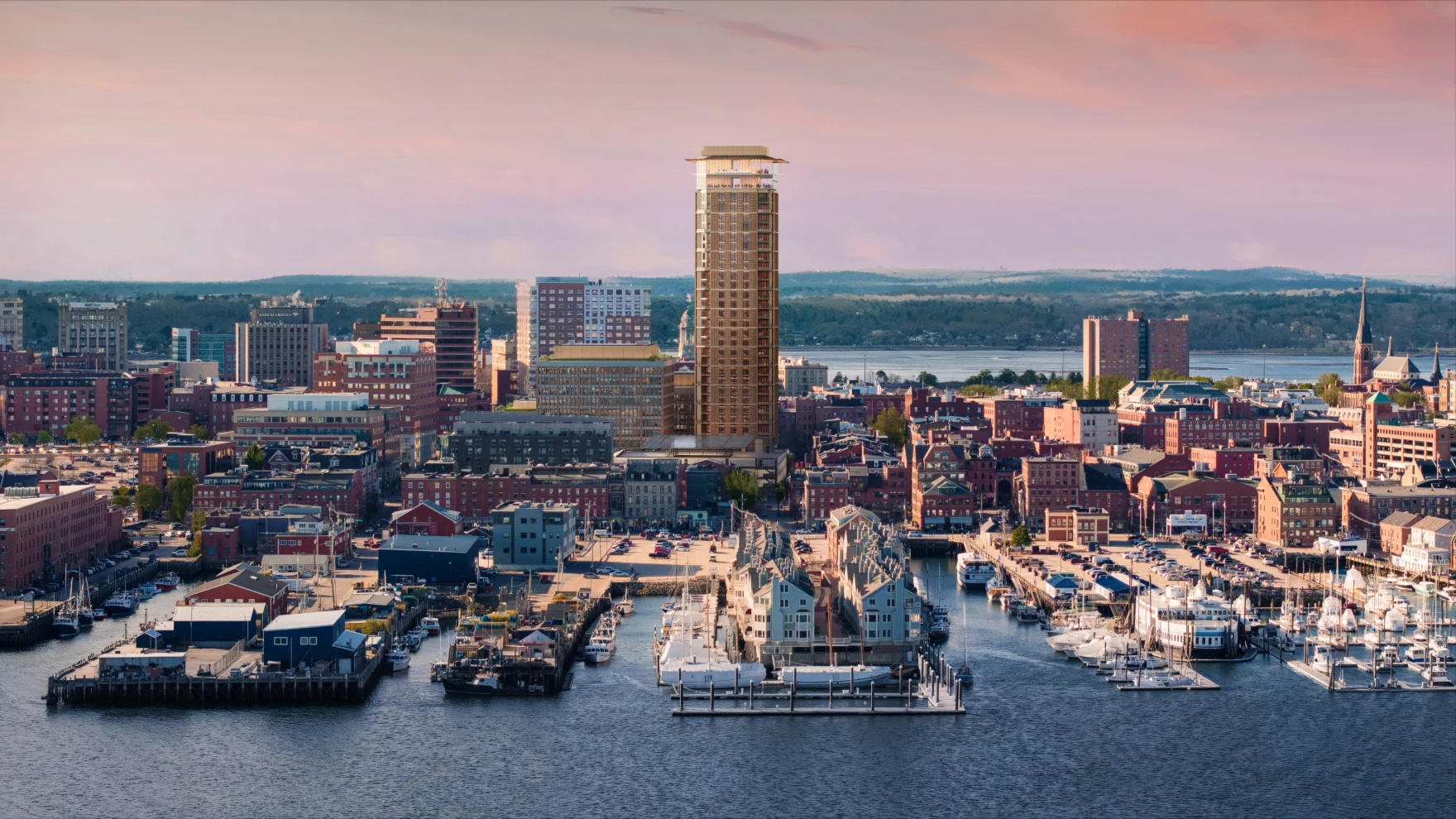
One of the first proposals Portland’s planning commission will consider since Recode’s passage suggests a shift has already taken place. In May 2025, Portland developer Tim Soley and “acclaimed” Israel-Canadian architect Moshe Safdie unveiled plans to erect a 30-story, 380-foot skyscraper at the edge of Portland’s historic port district.
This tower will rise from one of Portland’s vacant downtown lots, as shown below. It’s a brazen middle finger to the community vision expressed in Portland 2030 and the city’s climate action plan. The developer and architect claim that residents will love it. The so-called inspiration? A lighthouse.
Over the twenty years ending in 2020, Portland became a better version of itself. Efforts there steered the city in the direction of highly desirable places like Zurich, Vienna, and Copenhagen. These cities contrast sharply with high-rise meccas such as Hong Kong, Dubai, or Shenzhen. Per Mercer’s global “Quality of Living City Rankings,” Zurich, Vienna, and Copenhagen are ranked 1, 2, and 4, while Hong Kong, Dubai, and Shenzhen fall far behind at 76, 83, and 139.
There’s good reason for the difference in results. Quality of life matters and it shapes environmental outcomes. A central point this series has emphasized is that building at the human scale is synonymous with climate change mitigation.
Expanding the human scale, in turn, is dependent on a municipality pursuing four objectives that I’ve describe separately. A full analysis of Portland is beyond the scope of this article, but suffice it to say, these preconditions have not been established. I don’t point this out to blithely dismiss Portland’s accomplishments. However, when a municipality’s principal focus is on densification, height, “nodes”, and “corridors” rather than design, things go sideways.
One of the most capable and informed planning directors in America told me 25 years ago that, “Speaking in terms of density boxes you in and interferes with good design.” ReCode, despite its visible strengths, was a participatory zoning process, not a participatory design process.
Participatory design is required to create a regulatory framework for both discretionary and as-of-right development of the sort that produces a compelling public realm. A compelling public realm, in turn, enables us to comfortably travel by foot or bike in any direction for long periods of time. If you really want to get people out of their cars and reduce emissions, don’t speak in terms of nodes and corridors. Speak in terms of the quality of the walk.
Creating this kind of environment is dependent upon exhaustive stakeholder analysis, and context sensitive decision making in a compressed timeframe. Such efforts were not funded and executed in Portland due to a lack of political will at both the municipal and state level.1 As a result, the city may have a near term future filled with development decisions that contravene their own climate goals and sorely test those involved in establishing Portland’s community vision.
At the end of the day, I encourage Portland’s municipal politicians, planners, and planning board members simply to make the nine hour drive to Halifax, Nova Scotia. They can answer for themselves whether the emphasis on density, corridors, nodes, and height is what they really want.
Previously, Part 7 contrasted the false promise of electric vehicles in Halifax with land use reform to reduce auto-dependency in Portland. . Initially: The first article in the series (Part 1) placed municipalities at the center of the climate crisis.
- Using participatory design (a.k.a., design charrettes) to create a regulatory framework is analogous to an investment in infrastructure. They’re expensive, and state legislators need to see their value provide municipalities with financial support. ↩︎


